4.8.15 Network Interaction Diagrams
These diagrams follow one successful connection and stream through their lifecycle. They complement the public API overview; they are not additional protocol rules. Mermaid-capable Markdown viewers, including GitHub, render them as sequence diagrams. Each section also links to a rendered PNG that can be opened directly in an image viewer such as Emacs, without a browser or Mermaid support. The Mermaid blocks remain the editable source; rendering instructions describe how to refresh the images.
Time runs downward. A and B are different hosts; a DID identifies a host’s
key. Each application supplies a NetworkMonitor for admission and lifecycle
notifications. Uppercase messages such as OPEN and DATA are wire frames;
lowercase method calls are local API calls. Dashed arrows show local returns, not
extra protocol acknowledgments. Parallel blocks show independently progressing
work, not a requirement that both events happen simultaneously.
The connection/endpoint lifelines group several implementation objects and workers for readability. In reality each established connection has one transport reader, one transport writer and a service/timer; an opening has its own admission worker. Callbacks and credential work run outside owner/stream locks. The drawings omit locks, retries, renewal and most failure paths. They show representative successful interleavings, not a global synchronization barrier between hosts.
4.8.15.1 Opening a Connection
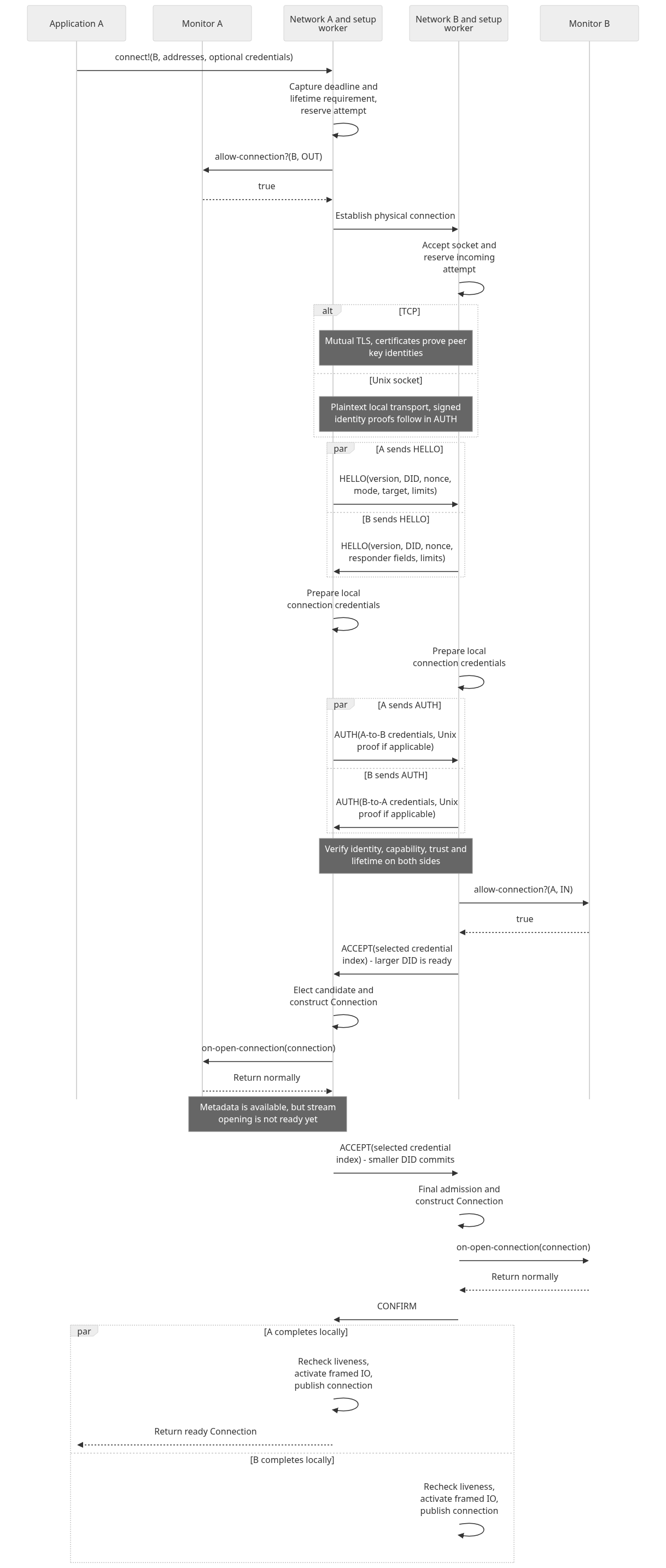
Assume B is already listening, there is no reusable connection, and A dials B and has the lexicographically smaller canonical DID. This assumption makes the asymmetric election easy to see. If the dialer’s DID is larger, the physical dial direction stays the same but the two ACCEPT roles and CONFIRM direction reverse.
sequenceDiagram
    participant App as Application A
    participant MA as Monitor A
    participant A as Network A and setup worker
    participant B as Network B and setup worker
    participant MB as Monitor B

    App->>A: connect!(B, addresses, optional credentials)
    A->>A: Capture deadline and lifetime requirement, reserve attempt
    A->>MA: allow-connection?(B, OUT)
    MA-->>A: true
    A->>B: Establish physical connection
    B->>B: Accept socket and reserve incoming attempt
    alt TCP
        Note over A,B: Mutual TLS, certificates prove peer key identities
    else Unix socket
        Note over A,B: Plaintext local transport, signed identity proofs follow in AUTH
    end
    par A sends HELLO
        A->>B: HELLO(version, DID, nonce, mode, target, limits)
    and B sends HELLO
        B->>A: HELLO(version, DID, nonce, responder fields, limits)
    end
    A->>A: Prepare local connection credentials
    B->>B: Prepare local connection credentials
    par A sends AUTH
        A->>B: AUTH(A-to-B credentials, Unix proof if applicable)
    and B sends AUTH
        B->>A: AUTH(B-to-A credentials, Unix proof if applicable)
    end
    Note over A,B: Verify identity, capability, trust and lifetime on both sides
    B->>MB: allow-connection?(A, IN)
    MB-->>B: true
    B->>A: ACCEPT(selected credential index) - larger DID is ready
    A->>A: Elect candidate and construct Connection
    A->>MA: on-open-connection(connection)
    MA-->>A: Return normally
    Note over MA,A: Metadata is available, but stream opening is not ready yet
    A->>B: ACCEPT(selected credential index) - smaller DID commits
    B->>B: Final admission and construct Connection
    B->>MB: on-open-connection(connection)
    MB-->>B: Return normally
    B->>A: CONFIRM
    par A completes locally
        A->>A: Recheck liveness, activate framed IO, publish connection
        A-->>App: Return ready Connection
    and B completes locally
        B->>B: Recheck liveness, activate framed IO, publish connection
    end
Identity and permission are separate: TLS or the Unix proof identifies the key,
while UCAN credentials authorize the connection. Use proto:/network/connect when
creating those credentials. The installed connection expiration is the minimum
expiration of the two accepted credentials, not a fresh TTL measured at publication.
The first ACCEPT is readiness, not commitment. The smaller DID coordinates initial election even if it did not dial. This is distinct from renewal coordination, which belongs to the original physical initiator.
on-open-connection is a final-admission callback, not a readiness event. It must
return promptly. If a callback hands the Connection to an application worker, that
worker can use connect!(peer, []) to await ready publication before opening a
stream; it must not block the callback itself on that operation.
Existing connections take shorter paths: a covered/default request reuses the live Connection, and concurrent callers can join an already-pending attempt. Those paths do not repeat the handshake or open callbacks. Failed authentication/admission may send REJECT or close the candidate; only normally completed open callbacks earn matching close notifications.
Details: handshake, election and publication, and authentication.
4.8.15.2 Opening a Stream
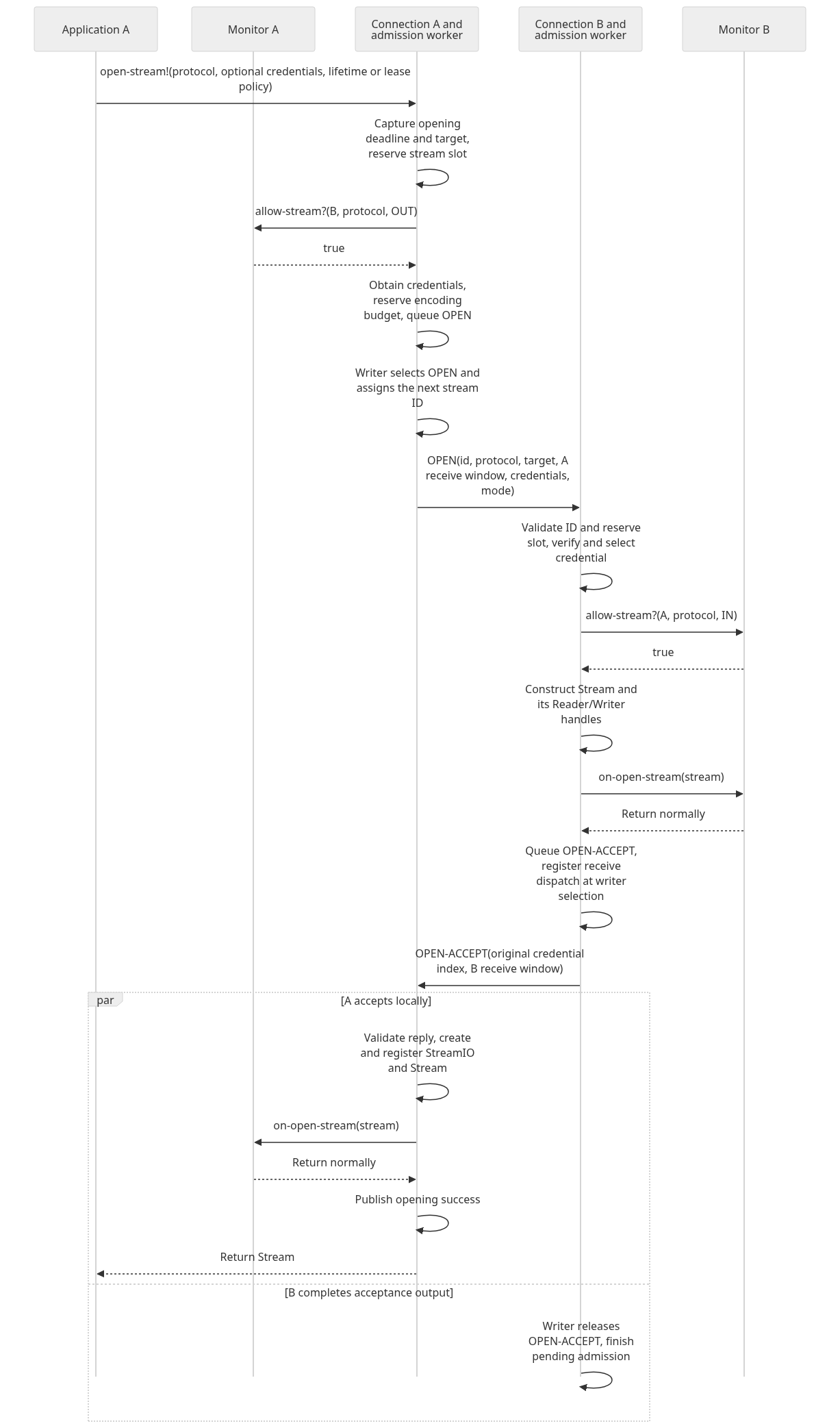
Either endpoint can open streams once the connection is ready. Here A opens one protocol stream on an existing connection; no new socket or TLS handshake is needed. The initial stream credential authorizes opener-to-recipient use of the requested protocol. There is no separate reciprocal credential exchange for response DATA.
sequenceDiagram
    participant App as Application A
    participant MA as Monitor A
    participant A as Connection A and admission worker
    participant B as Connection B and admission worker
    participant MB as Monitor B

    App->>A: open-stream!(protocol, optional credentials, lifetime or lease policy)
    A->>A: Capture opening deadline and target, reserve stream slot
    A->>MA: allow-stream?(B, protocol, OUT)
    MA-->>A: true
    A->>A: Obtain credentials, reserve encoding budget, queue OPEN
    A->>A: Writer selects OPEN and assigns the next stream ID
    A->>B: OPEN(id, protocol, target, A receive window, credentials, mode)
    B->>B: Validate ID and reserve slot, verify and select credential
    B->>MB: allow-stream?(A, protocol, IN)
    MB-->>B: true
    B->>B: Construct Stream and its Reader/Writer handles
    B->>MB: on-open-stream(stream)
    MB-->>B: Return normally
    B->>B: Queue OPEN-ACCEPT, register receive dispatch at writer selection
    B->>A: OPEN-ACCEPT(original credential index, B receive window)
    par A accepts locally
        A->>A: Validate reply, create and register StreamIO and Stream
        A->>MA: on-open-stream(stream)
        MA-->>A: Return normally
        A->>A: Publish opening success
        A-->>App: Return Stream
    and B completes acceptance output
        B->>B: Writer releases OPEN-ACCEPT, finish pending admission
    end
The callback ordering is deliberately asymmetric: B’s on-open-stream precedes
OPEN-ACCEPT output; A’s follows validated receipt. B registers receive dispatch at
ACCEPT selection because A can respond before B’s local write-release bookkeeping
finishes. B’s own DATA still follows OPEN-ACCEPT through the same single writer.
Callbacks should hand IO to application workers rather than wait for it inline.
The advertised windows grant initial credit toward the advertiser: A’s OPEN window permits B-to-A DATA; B’s OPEN-ACCEPT window permits A-to-B DATA. No separate initial WINDOW-UPDATE is required. IDs are allocated in actual OPEN output order: the physical connection initiator uses odd IDs, the responder even IDs.
Stream.expire is the selected credential’s expiration. In fixed mode the requested
expiration uses the stream TTL/absolute-expiration rules; linked mode captures the
installed connection expiration and later reauthorizes the same stream as needed.
Opening a stream never renews its connection. Refusal before acceptance uses
OPEN-REJECT; cancellation after acceptance can require RESET. Unrelated streams
remain usable unless the failure is connection-fatal.
Details: stream admission and public stream contracts.
4.8.15.3 Sending Data
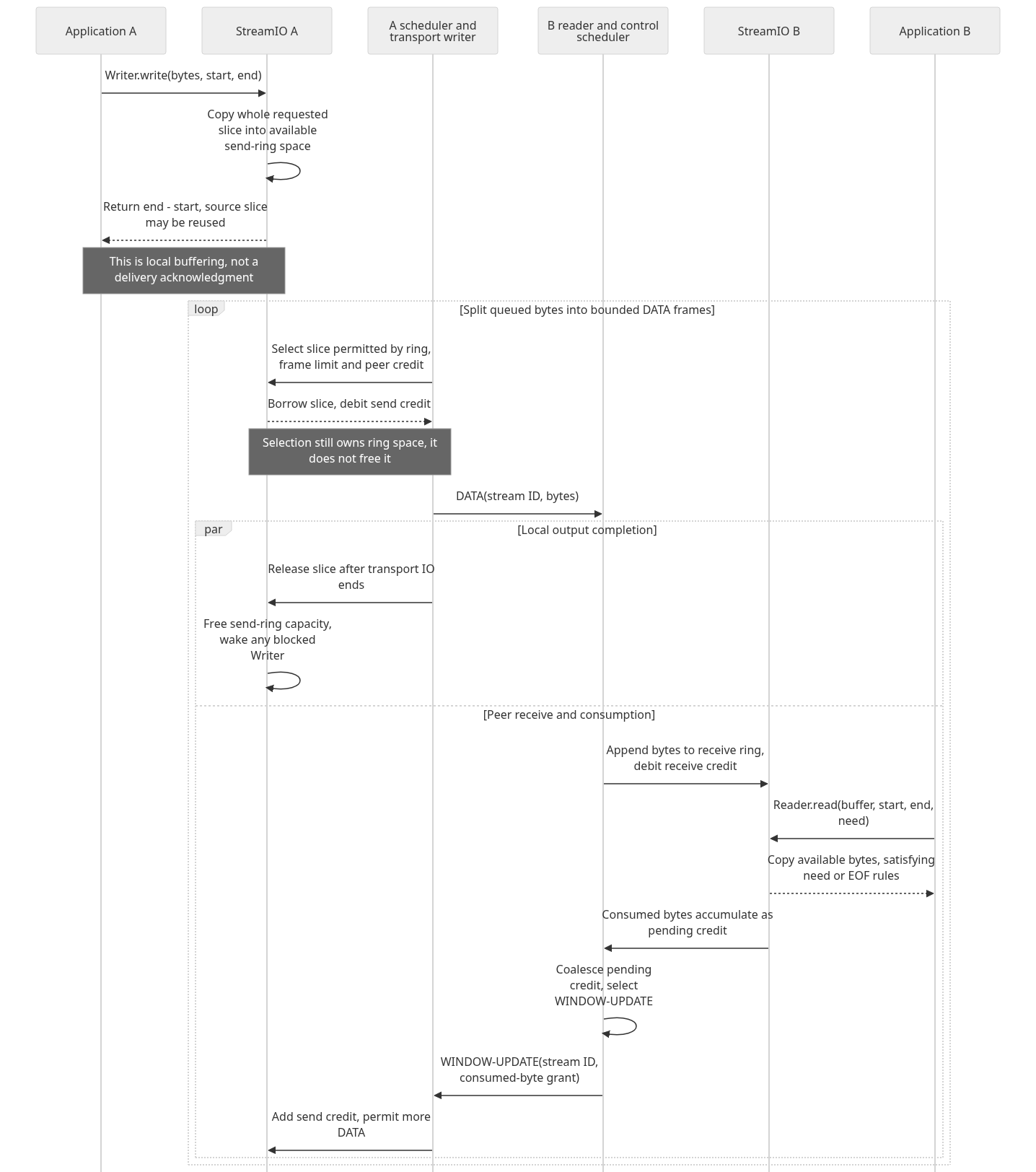
Two independent limits govern progress: local send-ring space and credit from the peer. This example starts with a write small enough to fit the local ring. A larger call waits and copies successive portions under one deadline, returning only when its entire requested slice has been copied.
sequenceDiagram
    participant AppA as Application A
    participant SA as StreamIO A
    participant A as A scheduler and transport writer
    participant B as B reader and control scheduler
    participant SB as StreamIO B
    participant AppB as Application B

    AppA->>SA: Writer.write(bytes, start, end)
    SA->>SA: Copy whole requested slice into available send-ring space
    SA-->>AppA: Return end - start, source slice may be reused
    Note over AppA,SA: This is local buffering, not a delivery acknowledgment
    loop Split queued bytes into bounded DATA frames
        A->>SA: Select slice permitted by ring, frame limit and peer credit
        SA-->>A: Borrow slice, debit send credit
        Note over SA,A: Selection still owns ring space, it does not free it
        A->>B: DATA(stream ID, bytes)
        par Local output completion
            A->>SA: Release slice after transport IO ends
            SA->>SA: Free send-ring capacity, wake any blocked Writer
        and Peer receive and consumption
            B->>SB: Append bytes to receive ring, debit receive credit
            AppB->>SB: Reader.read(buffer, start, end, need)
            SB-->>AppB: Copy available bytes, satisfying need or EOF rules
            SB->>B: Consumed bytes accumulate as pending credit
            B->>B: Coalesce pending credit, select WINDOW-UPDATE
            B->>A: WINDOW-UPDATE(stream ID, consumed-byte grant)
            A->>SA: Add send credit, permit more DATA
        end
    end
Local output release and the peer’s receive/read/update path can interleave. Only actual transport release frees a borrowed send slice; it does not restore peer credit. Only received WINDOW-UPDATE grants restore send credit. A peer read creates pending credit, which may be coalesced before its update is selected for output. Consumption can generate credit even while a large minimum read is still waiting.
There is no per-DATA acknowledgment, and write calls, DATA frames and read calls do not correspond one-to-one. With no peer credit, DATA scheduling waits; with no local ring space, application writes wait. Control frames and other eligible streams continue subject to the shared scheduler’s bounded capacity and fairness rules. The reverse byte direction uses its own rings and credits through the same connection.
Details: byte IO, bounded stream state, and managed scheduling.
4.8.15.4 Gracefully Closing a Stream
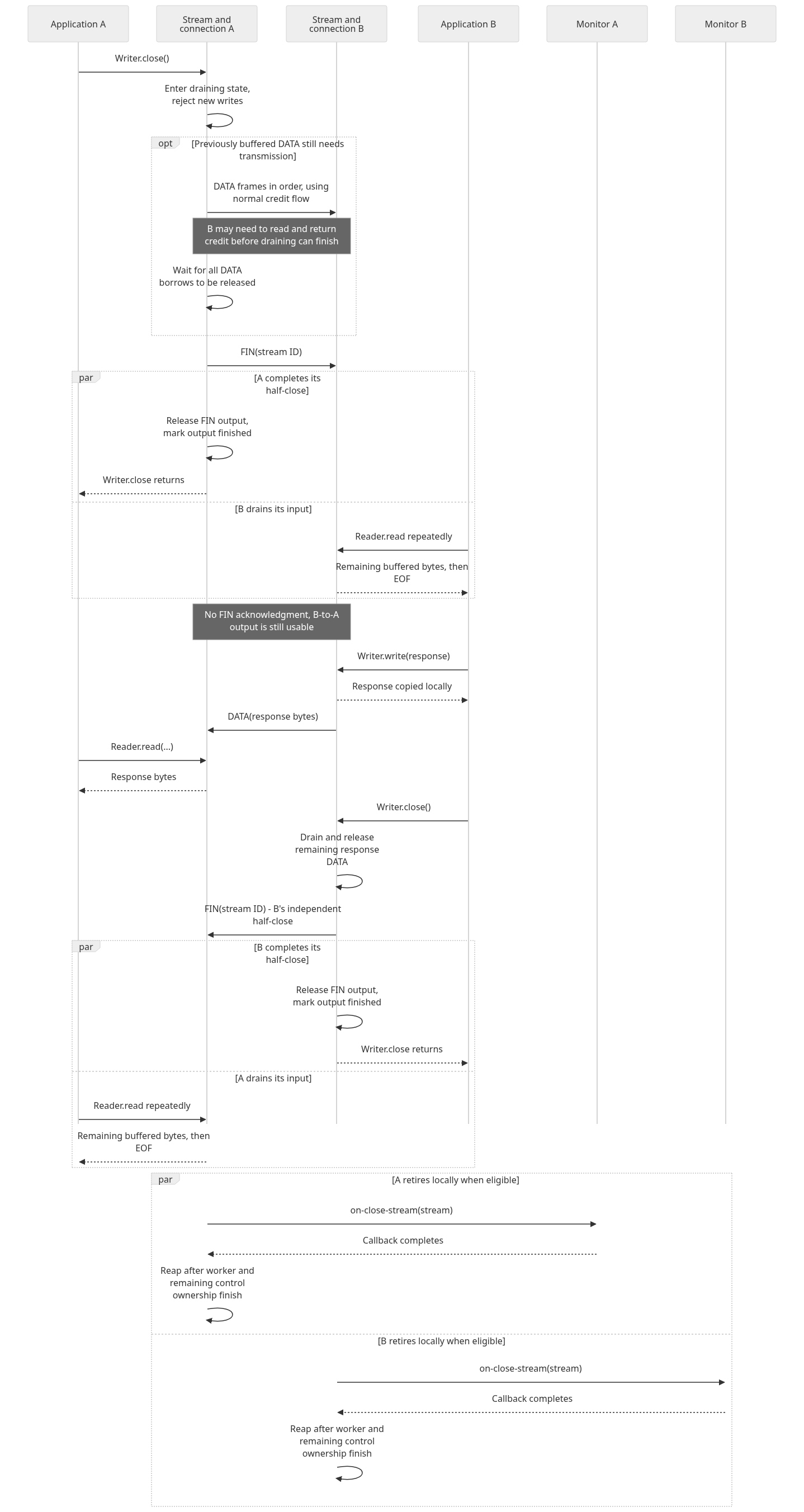
Close the Writer to finish sending gracefully. Stream.close and Reader.close
are abortive, not shortcuts for this exchange. Below A finishes its request, B reads
through EOF and sends a response, then B independently finishes its output.
sequenceDiagram
    participant AppA as Application A
    participant A as Stream and connection A
    participant B as Stream and connection B
    participant AppB as Application B
    participant MA as Monitor A
    participant MB as Monitor B

    AppA->>A: Writer.close()
    A->>A: Enter draining state, reject new writes
    opt Previously buffered DATA still needs transmission
        A->>B: DATA frames in order, using normal credit flow
        Note over A,B: B may need to read and return credit before draining can finish
        A->>A: Wait for all DATA borrows to be released
    end
    A->>B: FIN(stream ID)
    par A completes its half-close
        A->>A: Release FIN output, mark output finished
        A-->>AppA: Writer.close returns
    and B drains its input
        AppB->>B: Reader.read repeatedly
        B-->>AppB: Remaining buffered bytes, then EOF
    end
    Note over A,B: No FIN acknowledgment, B-to-A output is still usable
    AppB->>B: Writer.write(response)
    B-->>AppB: Response copied locally
    B->>A: DATA(response bytes)
    AppA->>A: Reader.read(...)
    A-->>AppA: Response bytes
    AppB->>B: Writer.close()
    B->>B: Drain and release remaining response DATA
    B->>A: FIN(stream ID) - B's independent half-close
    par B completes its half-close
        B->>B: Release FIN output, mark output finished
        B-->>AppB: Writer.close returns
    and A drains its input
        AppA->>A: Reader.read repeatedly
        A-->>AppA: Remaining buffered bytes, then EOF
    end
    par A retires locally when eligible
        A->>MA: on-close-stream(stream)
        MA-->>A: Callback completes
        A->>A: Reap after worker and remaining control ownership finish
    and B retires locally when eligible
        B->>MB: on-close-stream(stream)
        MB-->>B: Callback completes
        B->>B: Reap after worker and remaining control ownership finish
    end
Writer.close waits for queued DATA and FIN output completion, not for the peer
to consume those bytes or send its own FIN. Its original drain deadline still
applies; repeated close joins that drain rather than restarting the deadline.
The peer preserves unread input after FIN. EOF returns zero once no bytes remain
and the requested minimum permits it; asking for more bytes than remain can raise
PrematureEndOfInput instead. That expected EOF condition does not abort reverse IO.
Each endpoint becomes gracefully retirable when its own output is finished and its input has reached fully consumed EOF. The endpoints need not retire together. Close callbacks and actual slot reclamation are later lifecycle steps, not part of the peer’s acknowledgment of FIN. Actual slot reclamation also waits for any still-owned renewal work; the close callback can complete before that work is released. Metadata and the existing Reader/Writer identities remain available after retirement, but closed directions cannot be used again. The connection itself can continue carrying other streams.
For an abortive close, unread and unsent bytes are discarded and waiters are woken;
the parent schedules RESET as required by the stream’s state. Already borrowed DATA
remains owned until its writer releases it. Network.close is broader still: it
closes transport before cleanup and joins owned workers and eligible notifications.
Inline calls from monitor callbacks or any network-owned worker raise
ContractViolation before shutdown effects, including cross-network and already
closing calls. Dispatch close to an application thread and let the callback return;
that thread does not inherit the network-worker marker.
Details: stream half-close semantics, callbacks and retirement, and network shutdown.